

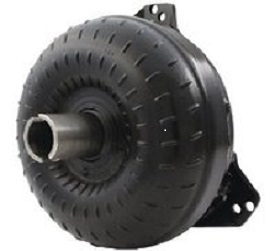
The automatic transmission torque converter is what provides the physical connection between the engine and transmission.
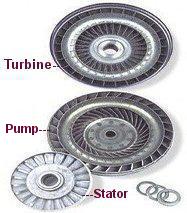
This fluid coupler operates through the principles of hydraulic force provided by 3 internal components (pictured below) and the hydraulic oil.
The torque converter takes the spinning motion of the crankshaft and applies that to the input shaft of the transmission.
A clever and ingenious part of this is that the converter automatically engages and disengages power from the engine to the drive line in relation to engine speed.
This low RPM area and when power begins to flow is known as stall speed. With the engine running at the correct idle speed there is not enough fluid flow for power to be transferred to the wheels.
This allows the engine to run at idle speed with almost no load, like the neutral position, without moving the vehicle in forward or reverse with the brakes lightly applied.
When the engine speed increases the increased fluid flow creates a sufficient amount of force to transmit the engine’s power and move the vehicle.
As an interesting side note I had a 1974 Dodge charger with Chrysler’s 904 3 speed automatic transmission. The torque converter malfunctioned internally and the stall speed disappeared.
Even though I had the engine idle set properly when I selected drive the engine would stall because of the internal problem. It took me a while to figure out what was wrong with it.
The Internal Converter Components
The front side of the hard shell physically bolts to the engines crankshaft. This is usually done by either a fly wheel or a flex plate that provides this physical connection to the crankshaft.
The attaching bolts are usually coated with Loctite (very important) to prevent them from coming loose with vibration.
The backside has a hole in it where the input shaft of the transmission slides in and seals. Inside the transmission torque converter is always filled with fluid and as mentioned above it is this fluid that connects the two halves together.
The automatic transmission torque converter consists of three internal components to help control the fluid coupling between the engine and transmission.
The three components are a pump assembly often called an impeller, a stator assembly and the turbine.
Working from the flywheel side it is the impeller assembly or pump that is driven by the crankshaft.
Moving towards the rear of the converter it is the stator assembly that is in the middle and provides a smooth fluid reaction and torque multiplication that is generated from the pump.
The turbine side of the torque converter is what provides the movement to the input shaft of the transmission.
How the Torque Converter Works
If there is no fluid inside the torque converter, it will not move the vehicle. It’s this hydraulic fluid that pulls all the components together. As the crankshaft rotates the pump impeller provides a centrifugal force that throws the transmission fluid outward and upward due to the curve shape of the impeller blades.
The faster the impeller rotates the greater this centrifugal force becomes and more fluid is pushed outward with greater force.
This fluid then strikes the curved blades of the turbine causing the turbine to rotate in the correct direction. Now a stator is a device that mounts between the impeller blades and the turbine blades.
It basically provides an efficient fluid motion and smooth flow. A turbine is connected to a hub that has splines inside. The input shaft of the transmission slides into the turbine hub.
An interesting point to make here is a turbine and the impeller are running at close to the same speeds, but they’re not running at exactly the same speed, because of energy lost to the fluid.
This creates slippage that can harm fuel economy. It is for this reason that manufacturers came up with a way to lock it all together to spin at a one-to-one ratio. They do this with a clutch that is operated by a solenoid that is computer controlled.
In the right conditions the torque converter clutch is applied and the crankshaft and transmission input shaft spins at the same speed. This clutch needs to be disengaged when the brakes are applied or the engine will stall.
For more information on how this transmission torque converter works together with other drive-train parts head back to the start page for this repair module and more articles about the automatic transmission The homepage for the you fix cars website is up next and provides a rundown of what else you can find here. This next link takes you to the Homepage for YouFixCars.com.