

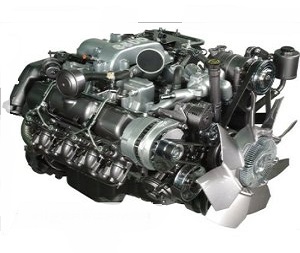
On this page you will quickly learn how a four stroke engine works and what each individual stroke performs in the cycle. Then we will tie it all together so you can see how these four strokes work together to provide power to an automobile.
When you fully understand the theory and operation behind four stroke engines, diagnosis and repair becomes easier. The first stroke of the cycle is called the intake. As the piston moves away from top dead center the intake valve opens. The downward movement of the piston increases the volume of the cylinder above it, which in turn reduces the pressure in the cylinder and causes a vacuum.
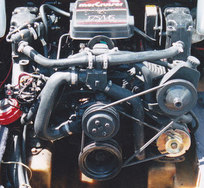
This vacuum physically pulls the air fuel mixture called a charge into the cylinder. The air fuel mixture will continue to enter the cylinder until the intake valve closes. The intake valve closes after the piston has reached bottom dead center.
This delayed closing of the valve increases the volumetric efficiency of the cylinder by packing as much air and fuel into the cylinder as possible. The passage ways leading to the intake valve are often smoothed to help pull in more charge without resistance. They refer to this as porting and polishing.
Four Stroke Engine Operation
The second stroke of operation is the compression cycle. This stroke begins as the piston starts to move from bottom dead center (BDC) upward towards the (OHV) over head valves.
After the intake valve closes and the exhaust vales are already closed this will trap the air fuel charge in the upper part of the cylinder know as the combustion chamber. The upward movement of the piston compresses the air fuel mixture that is trapped and thus heating the air fuel charge is acquired through compressing it.
The compression stroke is very important to the over all performance of the motor. Weak or leaking compression will cause lack of power, poor fuel economy, high tailpipe emissions and possibly a rough running condition.
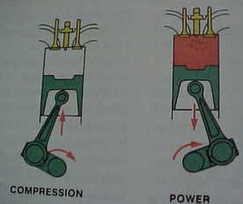
If you think you may have a problem in this area you can review my page about testing engine compression. At top dead Center (TDC) known as when the cylinder reaches the end of its upward travel a combustion chamber is formed.
This small sealed area is where the fuel charge will be ignited and burned. The total volume of the cylinder with the piston at BDC compared to the volume of the cylinder with the piston at top dead Center determines the compression ratio of the engine. In modern engines this is around 8.5 to 1.
The power stroke begins as the compressed fuel mixture is ignited and burned. With the valves closed an electrical spark across the electrodes of the spark plug ignites the air fuel mixture. The burning fuel rapidly expands creating a very high pressure against the top of the piston.
This process drives the piston down towards the bottom of its travel. This forced downward movement of the piston is transmitted to the connecting rod and then to the crankshaft. This one stroke is what drives the wheels and continues the engine’s rotational movement. The exhaust cycle is the final step in a four stroke engines operation.
The exhaust valve opens just before the piston reaches bottom dead center on the power stroke. The Pressure in the cylinder causes the exhaust gas to rush past the open valve and into the exhaust manifold. The movement of the piston from BDC to TDC pushes most of the remaining exhaust gas from the cylinder.
As the piston nears TDC, the exhaust valve begins to close as the intake valve starts to open. The exhaust stroke completes the four-stroke engine cycle. The opening of the intake valve begins the cycle again. This cycle occurs in each cylinder and is repeated over and over, as long as the engine is turning.
Help others find this page with a share on social.
Now that we understand why they call it a four stroke engine. We can go back to the automotive engine section to learn another piece of the engine operation puzzle. This next link takes you from the four stroke engine to automobile engines. Did you ever want to see what a bad cylinder looks like and how they fix it? I have a video for you that takes you inside for some engine diagnosis.
The you fix cars homepage is a good place to discover what else can be found on this automobile repair website. You can also learn more about the mechanic that thinks many can Diy with some auto repair advice.