

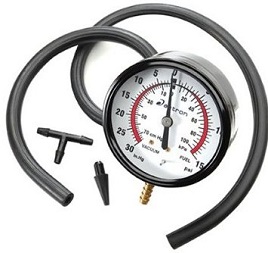
Engine vacuum tests are another great method of pinpointing engine problems as well as determining the overall health of your vehicles power plant. Manifold vacuum is tested with a vacuum gauge.
The downward movement of the piston forms vacuum during the intake stroke. If the cylinder is properly sealed a maximum amount of vacuum will be formed. This will also improve the volumetric efficiency and the power created by the engine. Why not make sure you’re getting the most out of the intake cycle. You can interpret or identify many engine conditions by monitoring vacuum readings.
You can test for proper valve timing, that works together with the spark or ignition timing to insure proper combustion. If the base timing setting is retarded, which is the opposite of advanced, a low steady reading can be observed on the test gauge.
You can also verify a free-flowing exhaust system with no clogs or restrictions. This is a great way to pinpoint issues without having to drop the exhaust. A clogged exhaust will show on the vacuum gauge as a low and steady reading that decreases, with increasing part throttle engine rpm.
A common restricted exhaust problem would be catalytic converter problems. This expensive emission component can break up and restrict the exhaust flow as the pieces shift around inside.
Ideally, each cylinder of an internal combustion engine will produce the same amount of vacuum. This is why the vacuum gauge readings should be steady and give a reading of at least 18 to 20 at closed throttle. A gauge needle that bounces around or is not steady as a rock can indicate an issue on 1 or more cylinders.
Interpreting the Tests Results
As mentioned if one or more cylinders produce less vacuum than the others the needle of the tester will fluctuate. When performing the engine vacuum test the intensity of the fluctuation of the needle indicates the severity of the engine problem.
For example, if the reading on the vacuum gauge fluctuates between 9 and 19. You should then look at the rhythm of the needle. If it stays at 19 inches of mercury, but drops to 9 and then quickly rises we know that reading is probably caused by a problem in only one cylinder.
If the gauge reads low all the time let’s say a reading of 10 inches and has no fluctuation. This would be a good or strong indication of a clogged exhaust system or large vacuum leak.
This could be an intake manifold gasket failure or a broken hose. As I touched on above an exhaust malfunction can include problems like clogged converters or restricted muffler filled with catalyst debris.
A smashed or damaged pipe or even vandalism such as the old banana up the tail pipe trick are other possible causes. If you disconnect the exhaust system in front of the catalytic converter and the vacuum returns to full strength, this would verify a clogged catalytic converter or other parts behind it.
What Causes Poor Tests Results
Stuck or burned valves and weak valve springs can cause in proper sealing of the combustion chamber. Therefore providing low test results. If you think this applies to your vehicle I put a page together about the old fashioned valve job.
Uneven compression caused by worn piston rings or damage cylinder walls can also cause a fluctuating vacuum reading. Leaking cylinder head gaskets can also lower the ability of your engine to create vacuum. And of course a manifold vacuum leak will also affect the readings. Engine vacuum testing is a cheap and easy diagnostic step in the right direction.
The tester itself can be found for $20 or less. The tests procedure is basically just connecting the gauge to a strong manifold vacuum source. Most engines will have a few places where you can pull a vacuum line off the manifold and insert the vacuum tester. I have also used the hose that goes to the power brake booster for a quick test. Just make sure that you reconnect the hose before driving the vehicle. Bookmark or share this engine vacuum testing procedure resource page.
If you need help with your engine troubles consider asking a professional auto mechanic. For more information on this service visit my page about car repair help.
When it comes to learning about automotive engines and how to perform simple inexpensive testing I have some more information that may prove helpful. This next link takes you from engine vacuum tests to engine diagnosis repair.
If you would like more information on how to test for engine problems on your specific vehicle take a look at my online car repair manuals page. Here you can see a video of the auto repair program in action. Learn more about the car mechanic that built this auto repair website. Also find more information about what is covered on this website that provides automobile repair advice.