

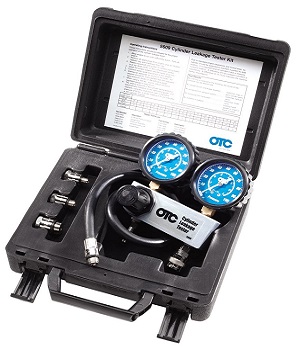
Here we’ll talk about why a cylinder leakage test should be performed if a compression test reveals low readings on any cylinders. We’ll also discuss how to do it the right way and properly interpreting the results.
These leak down tests are performed to measure the percentage of compression loss. They help to locate the source of the leak as well. Even if the answer is bad news it’s considered must know and helpful information.
Using the affordable specialized tool gives you the ability to pinpoint the problem area before you start tearing down the motor. It can also help you determine if the repairs are worth while on high mileage engines before you get started on a large project.
A leakage tester allows you to control and apply compressed air to a cylinder through the spark plug hole. Before the air is injected, the piston of that cylinder should be at top dead center on the compression stroke.
This is to ensure the intake and exhaust valves are closed. A threaded adapter on the supply end of the air pressure hose screws directly into the spark plug threaded hole.
The source of the compressed air is the shops air system, but small automotive compressors work. I have more on the compressed air side of the equation below
A built in pressure regulator on the tool controls the amount of pressure applied. A gauge registers the percentage of air lost from the cylinder when the compressed air is injected. The scale on the gauge is typically in easy to read percentages.
Cylinder Leak Test Readings
A zero reading means that there is no leakage in the cylinder at all.
A reading of 100 percent indicates that the cylinder will not hold any pressure whatsoever. Any reading that is more than zero indicates some leakage.
The location of the compression leak can be found by listening and feeling around various parts of the engine for air leaks. If air is felt or heard leaving the throttle plate assembly a leaking intake valve is likely.
If a bad exhaust valve is responsible for the cylinder leakage, air can be felt and heard leaving the exhaust system during the test. When air is heard escaping the cylinder head area than an inspection of the head itself must be performed. Possibilities include a cracked cylinder head or blown gasket.
Head Gasket Problems Cause Cylinder Leaks
On the subject of head gaskets when you apply compressed air to a cylinder and you hear air leaving the radiator this is a good indication of a faulty head gasket or even a cracked block.
You may also notice bubbles in the radiator overflow tank. Compression should be completely sealed from the cooling system and no air should enter any parts of the engine cooling system.
Another popular test for leaking head gaskets is the stuff pictured on the right. It changes color if a problem is indicated. If the test reveals a problem another possible cause could be worn piston rings.
In this case air can be heard, rushing down past the pistons and flowing into the crankcase and in extreme cases, you can feel air leaving the valve cover breather or vent tube.
I use compressed air when testing for a leaking cylinder. As I mentioned earlier the sound of rushing air out of the exhaust means a leaking exhaust valve.
The more air volume the easier to hear it. The rushing air through the intake means a intake valve problem. Internal engine diagnosis using compressed air can be very accurate and easier then other methods such as dis-assembly and inspection.
It is the repairs needed that will be the hard part. You will need an automotive compressor. Bigger is better but you do not need a giant one to test.
The volume of air required is small because you are only filling the combustion chamber not the whole cylinder. I have the small automotive compressor pictured above for home use.
It can fill tires and many other things as well. My artistic girl friend uses it to fill a small tank for air brushing make-up and nails as an example. You will have to adapt the hose to the right size fittings, but they are readily available at hardware stores.
Note that most engines even new ones will experience some cylinder leakage around the piston rings. And up to 20% is considered acceptable during your cylinder leakage test. You can check your online car repair manuals for the specs on your engine.
This is because when the engine is actually running the rings will seal much better due to the up-and-down movement of the piston and the presence of oil lubricating that cylinder.
Also note that there should be absolutely no leakage into the cooling system and also the cylinder head. The intake and exhaust valves should also seal at 100% with no leakage into the intake or exhaust systems.
In order of importance I perform a complete compression test first and then I performed a cylinder leak down tests as described above. The combination of these tests can often point to the area needing repair.
Bookmark or share this engine testing page with a friend.
You can learn more about how to perform the compression test from this next page. This next link takes you from cylinder leakage test to compression test procedures Learn the principles and operation of your automobiles power plant. This next page is the homepage for automotive engine repair.
Do you have questions that need answers sooner rather then later? Plug your question in on the next page and get some car repair help now!
This last link takes you to the about us page. Learn more about what is available on this car repair website and find advice for home auto repairs.