

Automobile Air Conditioning Systems
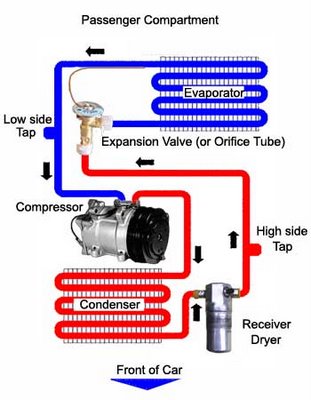
Automobile air conditioning systems are a closed pressurized system. It consists of a compressor, condenser, accumulator that is sometimes called a receiver dryer, and an expansion valve or an orifice tube and finally an evaporator. These components work together in your automotive ac system to create an output air temperature in the low 40° Fahrenheit range.
When you boil it down, the most important function of the automobile air conditioning system is to turn a high pressure Freon to a low-pressure refrigerant and this is done by the orifice tube or the expansion valve.
In the picture to the right the low pressure side is highlighted in blue and the high pressure side in red. Most systems today use the orifice tube type systems. You will find some vehicles that use an expansion valve instead of the orifice tube. An example would be heavy equipment, large trucks and a lot of Chrysler vehicles use the expansion valve. Note that you will have either one or the other but not both.
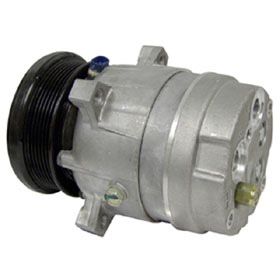
In a basic air-conditioning system, the heat is stored and transferred in the following steps. The refrigerant leaves the belt driven clutch operated compressor as a high pressure, high temperature vapor.
It is moved towards the condenser, where the vapor becomes a high pressure, high temperature liquid. It is changed from a gas to a liquid by the heat that is removed by the condenser component and the condenser fan that blows across it.
Sidebar; The r134a stop leak freon pictured to the right should only be used on a system with a very slow leak on the low side. It will not seal large refrigerant leaks. Be sure to follow the directions that come with the kit carefully so you don’t make things worse.
After the condenser the refrigerant is then circulated to the accumulator or receiver dryer where moisture and contaminants are removed. This is also where most of the Freon is stored until it is needed.
The expansion valve or orifice tube controls the flow of the refrigerant into the evaporator that is mounted inside the passenger compartment. It’s this step that converts the freon from a high pressure to a low one. This is where the auto AC system is the coldest.
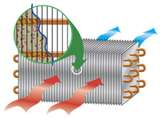
In fact if this step is not controlled properly the evaporator can turn into a block of ice. Many manufacturers place a probe on or near this part so they can monitor exactly how cold the evaporator coils are.
You may have heard people talk about low out put of cold air due to ice and not really understand why. You would think ice is a good thing on a hot day! If the evaporator freezes airflow through it is actually reduced and along with it the air temperature from the ducts is not as cool as it could be.
Heat absorption from the air inside the passenger compartment by this low pressure Freon causes the liquid to vaporize and move out of the evaporator as a gas.
The refrigerant then returns to the compressor as a low-pressure gas, where it is compressed into a high-pressure vapor as the system starts another cycle. As a side note when you understand this flow and operation of the automobile air conditioning system you have also learned how your home ac works as well as your refrigerator.
Basic Air Conditioning Operation
To understand the operation of the five major components of an automotive A/C system remember that the air-conditioning unit is divided into two sides. The high side of the system and the low side of the vehicle’s air conditioner.
The high side of the system referrers to the parts that are under high pressure and high temperature. These components are identified by smaller diameter tubing and very hot to the touch components. The low side of the system referrers to low pressure components that are larger in diameter as far as the hoses and tubing and these components will be ice cold to the touch.
This is very handy for diagnosis. If you have a high-pressure line that is warm and then turns cold in line or even a frozen spot, this will indicate that there is a clog in this component.
This page was meant as an overview for a better understanding of your cars air conditioning system. Please return to the Main page that will provide more information on diagnosis and repair and a more detailed description of individual components of your automobile air conditioning.
Give this resource page a bookmark or share with a friend having car problems. Then explore some more air conditioning information.
If you would like diagnostic tree charts and component locations for your specific AC system, visit my page about car repair manuals.
The homepage is up next and provides a run down of the auto repair content you can find on this automotive website. You can also learn more about the mechanic that thinks you can perform your own car repairs.