

Some would say the rear differential is where the rubber meets the road.
In fact, when the drive shaft torque is applied to the input side of the pinion gear the power and motion is transferred to the ring gear which flows out through the axles.
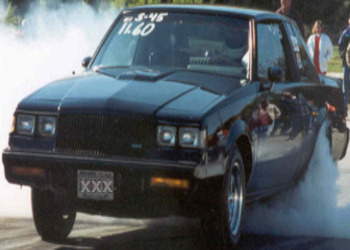
Of course the axles attach to the wheels and rubber tires that actually contact the road. So that opening statement would seem accurate. If you make it to the bottom of the page I have a sweet grand National Posi burnout video worth watching.
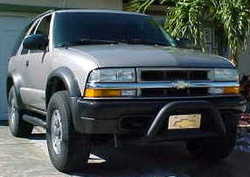
Most people I know with rear wheel drive vehicles want a posi-traction or positive locking rear end. I know I do! In fact my 2004 Chevy Blazer with the ZR2 package has the General Motors posi-lock limited slip differential rated to tow 6,000 lbs.
This type of rear end is greatly appreciated on the steep boat ramp in our development. People without limited slip differentials and powerful engines may be known as the one wheel wonder.
When they slam their gas pedal to the floor from a dead stop they spin only one wheel and tire. In the instance of a limited slip differential a clutch is activated by this spinning action that sends power to the wheel with more traction.
How the Rear Differential Works
One of the most important things about a rear differential is how it operates around corners. It uses side gears or spider gears for cornering.
When a vehicle turns into a curve or goes around even a slight bend the wheels on the outside have to travel a greater distance than the wheels that are tracking on the inside.
If it wasn’t for this situation the two axles could just be linked together and everybody would have a positive locking rear end.
The operation of the spider gears allows for the rear wheels to turn at different speeds when cornering. This also provides beneficial handling characteristics.
Noise from Rear Differentials
Where this knowledge comes in handy is for noise diagnosis.
If your vehicle only makes noise or has a problem when cornering then the inspection of the spider gears or often called side gears should be performed.
If there is no noise when the vehicle is traveling straight-ahead the ring and pinion gears and their associated bearings are probably not having a problem.
In the case of an automatic positive traction type differential such as the one on my 2004 Chevrolet Blazer, noise diagnosis can be more complicated, because of the additional components involved in the locking operation.
These types of rear ends have a clutch pack that transfers power to the wheel with the most traction. When the wheels are not slipping this clutch should be released and allow the vehicle to corner normally.
Problems with the clutch pack can be mistaken for problems with the side gears or spider gears. Also in the lubrication fluid the General Motors mechanical locking differentials contain a special additive to prevent sticking of the clutches when they apply and release.
If regular gear oil is installed in a positraction unit with no special additive, grabbing, jerking and noise can occur around corners. Check the auto repair manual for your specific vehicle to make sure you have the correct fluid installed in the rear differential.
Give this car and truck repair page a bookmark or share with a friend.
The main page for manual drive trains and associated parts is up next. Find information about clutches, axles, drive shafts and more about the rear differential.
If this is your first visit to the website you might want to check out the YouFixCars.com Homepage. It provides an overview of what is available here and provides information about getting repair questions answered.
Are you having a different kind of drive-train problem not addressed here? You can ask a mechanic right now and receive a timely answer with the Just Answer quality assurance guarantee on the car repair help page.