

The engine compression test will bring you back to the basics of engine diagnosis. Sometimes do it yourself Auto mechanics will start looking for the root cause of their problems in high tech automobile systems.
In many cases they will actually find failures in the most basic automotive systems. On this page we will discuss compression test procedures and how to analyze the results.
Even if this test does not uncover your problem, it will still give you a great indication of your engines overall health. I also recommend it for people buying high mileage used automobiles. Why perform a compression test? Internal combustion engines depend on the compression of the air fuel mixture to maximize the power produced by the engine.
The upward movement of the piston on the compression stroke will compact the air fuel mixture within the sealed chamber raising the temperature of the charge. This makes it easy to ignite and supports complete combustion.
An engine with poor compression or uneven results as in different readings from cylinders above or below 30 psi or low total compression can get very poor fuel economy and may not be able to pass a required State emission smog test.
It will also not run correctly and can’t be tuned properly. You cannot make adjustments on modern engines to compensate for low compression. If a rough running engine condition is present this might be considered a symptom that suggests the cause of the problem might be poor compression. Keep in mind other problems can cause this condition.
The Test Procedure Explained
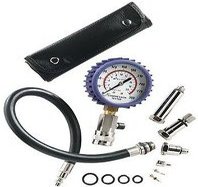
A calibrated test gauge is used to check the cylinder sealing capabilities. Before conducting a compression test, it is recommended to disable the ignition and the fuel system so the motor does not fire up during testing.
It is also recommended to prop open the throttle plate into a wide-open position to allow an unrestricted amount of air to enter the cylinder during the engine test. I like to mark the spark plug wires and remove all the spark plugs.
Connecting a remote starter button to the starter system will allow you to perform the tests on your own instead of having someone crank over the engine for you. This is highly recommended for mechanics that find themselves flying solo as we often do.
Install the compression gauge/tester on the number one cylinder. Most compression gauges are easy to use (I prefer a digital one) and have the same size thread as the spark plug and just screws into the spark plug hole. Next Crank the engine over and allow it to turn at least four revolutions. Then write down the reading after the fourth.
After you perform this procedure on all cylinders, you can then compare the pressure readings. Note that before you remove the compression gauge from each cylinder make sure you release the pressure by using the release valve on the tester. Failing to do so can damage the threads.
Evaluating Test Results with Low Readings
If you have several cylinders or even one cylinder with an unusually low reading a wet test is then recommended. The procedure performed above is called a dry engine compression test.
A wet test is when you squirt a small amount of engine grade oil into the weak cylinders. Reinstall the gauge into that cylinder and then conduct the test the same way as above by cranking the engine at least four revolutions.
Document the reading next to your dry reading that you recorded earlier and subtract. If the reading increases more then 10-15 psi with the presence of oil in the cylinder the most likely cause of the low reading is poor piston ring sealing. This is an indication that the rings are simply worn and often found on engines with high miles.
The engine compression test is quick and easy to perform on some cars. The results obtained from the procedure can give you an over view of the engines health. If a cylinder has low results there could be a few other reasons for the poor readings.
Things that can cause low compression are burned valves, a blown head gasket and worn rings. Also a slipped timing belt or chain that holds the valves open during the compression stroke.
Three more I can think of would be worn valve seats, a cracked cylinder head, or even an engine block crack can also cause compression problems. The test does not tell you exactly what is wrong with the vehicle. But it does in many situations point you in the right direction. This saves you the time of checking items that are not related to the car problem your having. Another quick test that goes hand in hand with a compression test is the engine vacuum test.
Learning about how the engine produces power and converts reciprocal movement to rotational force is recommended. Read my article that explains each cycle in a 4 stroke engine. I have lots more free automotive education articles on the subject of engines in cars. This next link takes you from engine compression test to the automotive engines section.
The you fix cars homepage provides a few highlights of what else is covered on this website. This is also a good place to get some Diy auto repair help.