

Car Steering Parts Information
Checking car steering parts is best accomplished when the vehicle is on the ground in the park position and with the wheels pointed straight. This is sometimes referred to as checking the suspension while loaded.
This is the same way the parts are used while driving. Checking the vehicle while on a lift with the front wheels hanging is okay for some suspension parts, but this is not recommended for steering parts.
Failure to check them loaded can result in poor diagnosis. I provide a model specific example on this page about a Nissan Maxima thump complaint.
After your automobile has been safely positioned in the inspection area, with the wheels blocked, parking brake set and the gear selector in park to assure it does not roll, you’re now ready to check for front end steering looseness.
This is easiest to accomplish with an assistant that will be able to rock the steering wheel back and forth while you inspect the movement on each individual joint with a flashlight in hand.
I recommend using the same procedure to check all steering parts and getting yourself into a routine that becomes second nature. I start my inspection on the driver side outer tie rod end and work myself to the passenger side of the vehicle one ball and socket joint at a time.
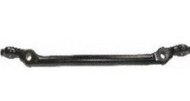
During this inspection I will check the tie rod ends both inner and outer, the center link, idler arms, damper shock (if equipped), steering box and Pittman arm. Here’s a little more detailed information about tie rod ends and checking these car parts. Tie rods are ball and socket type joints.
Checking Car Steering Parts
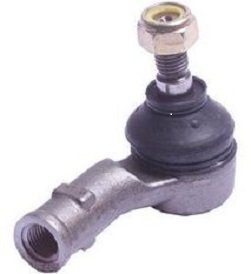
When these parts are mounted on a rack and pinion type steering the inner tie rod end will look quite different than the outer, but they do the same thing.
In most cases these inner joints are still considered ball and socket type parts. Hence, they are checked in the same manner for looseness. You can use the procedure described above with an assistant or you can do it yourself which is a little more difficult.
In either case you’ll be looking for total loose movement and checking these against your auto repair manual specifications. Loose movement or free-play is when the joint moves, but the part it’s connected to does not. Again, remember that some movement or play is allowed in these ball and socket type joints.
Worn tie rod ends can result in incorrect toe settings when a vehicle wheel alignment is performed. This can also cause extreme tire wear. This kind of tire wear is sometimes referred to as scuffed, feathered or scalloped.
Worn tie rods can cause wheel shimmy or complaints about loose and poor steering. Often when these front end parts are this loose a complaint from the driver about abnormal noise like creaking, clicking, popping and maybe even squeal on turns or over bumps.
Checking Tie Rod Ends for Looseness
In most cases movement that is over 1/8 of an inch or 3 mm will require a replacement of the tie rod end. Factory type service manuals provide specifications and procedures for measuring the free play.
This is a case when a repair manual can stop an unnecessary repair. Another thing to inspect is the ball and socket joint to make sure that the rubber boot that seals in the grease is in good condition. And make sure the joint has the proper amount of lubrication.
You also want to do a good job of checking the tie rod sleeves. These are adjusting sleeves that resemble a piece of pipe that has internal threads. One end of the threaded pipe has reversed threads that allow adjustment of the total length of the assembly for toe in alignment settings.
If the vehicle has suffered an impact to the tire or wheel such as a major pothole or the automobile hit a curb the tie rod adjustment sleeves will bend before the solid steel joint. Sometimes the damage to these car parts is hard to see with the naked eye and an alignment may be necessary to pinpoint a slightly tweaked adjustment sleeve.
Note that if you are going to replace inner and outer tie rod ends at the same time you might as well replace the sleeve at the same time.
The adjuster sleeve is inexpensive and makes the job less time consuming, as you will not have to torch or soak the old sleeve in liquid wrench.
When it comes time to replace tie rod ends or other front end car parts sometimes special equipment can make the job easier. On rack and pinion steering an inner tie rod tool is available.
This special tool makes the replacement easier, because you can do it without removing the rack and pinion assembly from the automobile. Even on conventional front steering suspensions a fork type splitter can make quick work of separating a tie rod and from the spindle.
The rest of the steering parts are discussed on the next page. Center links, Idler and pitman arms can be up sold during alignments. See what question to ask if these automotive steering parts are recommended. Learn more about the parts that hold up your car and provide control on unkind road surfaces. This next link takes you from car steering parts to automotive suspensions.
On the homepage (up next) you can browse through what else is covered besides car steering parts and find other do it yourself car projects. Also find out how to get some auto repair help.