

Since automotive steering parts are considered a safety item, sometimes they are up sold as a potentially life saving necessary repair during regular car maintenance.
For this reason alone, there is motivation to learn more about the major steering parts on your car.
When mechanics shake something and use the human eye to measure the amount of deflection or play there is too much room for error.
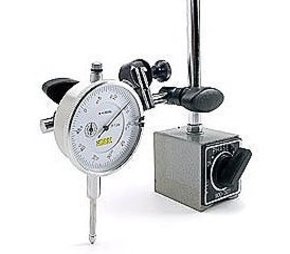
The proper procedure is to measure this movement with a dial indicator and compare it to the manufacturer specifications. This inexpensive tool mounts up quickly with a powerful magnetic base.
It can measure play in front end parts, back lash in pinion gears, cam and crank shaft end play, brake rotor run out, valve guide clearance and much more. At less then fifty dollars your mechanic should have at least one of these.
If a shop say’s you need a ball joint because of excessive play ask them how they diagnosed this.
Ask to see the specification from the manual and what was measured on the vehicle.
Some front end steering components can be replaced by do-it-yourself auto mechanics, and some should be left for the shop to replace.
The main reason for this is an alignment may be necessary after replacing the defective parts. As an example, the idler arm is only a pivot point, but if it’s severely worn it can make setting the toe difficult.
Replacing a idler arm will not affect or physically change the alignment settings themselves. If the alignment was set correctly before then just replacing the loose part is okay.
This is one of the commonly up sold auto parts and can be replaced by many DIY car mechanics. An example of when to pass on a do-it-yourself auto service would be replacing tie rod ends or adjusting sleeves.
Even if you take the time to take measurements before removing the old parts it’s really hard to get the new tie rod ends to the same exact measurement. Excessive toe in or toe out can cause extreme feathered tire wear and poor driving characteristics.
Car Steering Parts Description
One of the most stressed points in the steering system would be at the Pitman arm. This item attaches the steering gear box to the parts that actually move the wheels.
Therefore, this is the item that transmits the drivers back-and-forth movement on the steering wheel to steer the actual tires.
Some Pitman arms have a ball and socket joint and some are just a straight piece of steel with two tapered holes on either end.
When replacing OE parts removal can be difficult with out a pitman arm tool. You can check the ball and socket by shaking it with some vigor and check for any excessive movement or looseness.
If you have the type with just holes you can inspect them for signs of mushrooming, and also check the holes for becoming out of round or oblong.
If you have a second person make sure to first block the wheels for safety. Then with the transmission in park and the emergency brake set, your assistant can move the steering wheel left and right to provide the movement for checking the automotive Steering parts.
As mentioned above, the idler arm can become one of the first parts on the steering system to become loose and need to be replaced.
A worn or damaged idler arm can cause steering instability, front end shimmy, hard steering, on even tire wear on the front tires, as well as an excess amount of play or loose feeling in the steering wheel.
One nice thing when it comes time to check your idler arm for looseness is that the vehicle should be in its normal state and does not need to be lifted off the ground.
This automotive steering part is best checked loaded with both front wheels firmly planted on the ground and in the straight ahead position.
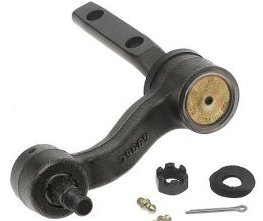
Check the idler arms ball and socket joint as described above by shaking and moving it while observing the amount of play in the joint.
It is important to remember that some movement is allowed in the ball and socket type joint. In the case of the idler arm the general specs can be up to a quarter inch of total movement is allowable.
Check your online car repair manuals for your vehicle’s specific specifications. As you become more experienced, you will learn what a quarter of an inch of travel looks like.
Until then it may be best to set up a dial indicator mentioned above and actually measure the amount of deflection. I’ve seen this procedure save a lot of technicians and customers a lot of time and money.
It’s not expensive and can be used on many other areas of the automobile. Basic sets are available for under $50, complete kits for about $75. As with most steering parts if it is borderline then replace it.
Some mechanics will lift the vehicle and shake the front wheels from side to side and then measure the up-and-down movement.
This is not a recommended procedure for checking idler arms. It’s a normally loaded steering component and should be checked that way.
A bad or worn center link can cause many front-end drive ability complaints. Example a front and shimmy, a vehicle pulling to one side or the other, and excessive tire wear caused by in proper total toe in settings.
Like the pitman arm, some center links will have ball and socket joints and some will have just tapered holes. Often when I discover a bad center link, it is due to damage from impact.
Even concrete parking barriers can tweak this automotive steering part out of specs. It is very important to inspect the link for being bent. If the damage or bend is only slight it may be necessary to inspect this component while on a front and alignment machine.